AWS Lambda Cold Start Contract That Bills Per Init as Hidden Runtime Tax
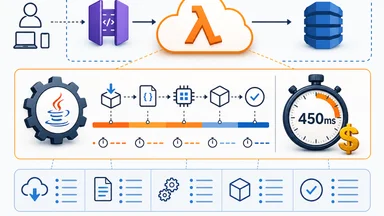
Every time an AWS Lambda function is invoked after a period of inactivity, the platform must initialize a new execution environment. This cold start adds 200 to 800 milliseconds of latency, and here is the part that rarely makes it into the README: AWS bills you for every millisecond of that init time. The init phase—loading runtime, dependencies, and user code—is charged at the same rate as your handler execution. This is not a bug. It is a deliberate pricing feature that quietly inflates serverless bills, and most teams do not audit for it.
Consider the economics: a Java function with a 450ms cold start running 10 million times a month at $0.0000166667 per GB-second (128MB memory) costs roughly $10 per month just for the init time. Scale to 512MB and higher concurrency, and that number multiplies. Unlike EC2, where idle time is visible as a running clock, Lambda's cold start tax is buried in the per-invocation billing line items. You cannot see it unless you instrument init duration yourself.
This hidden runtime tax is the subject of a growing number of engineering post-mortems. In a 2025 re:Invent talk, a fintech startup revealed that cold starts accounted for 30% of their total Lambda bill, with 15% attributable solely to init time. Their Java services suffered the most, but even Node.js and Python functions incurred 100 to 250 milliseconds of billable init. The pattern is clear: the more functions you have and the spikier your traffic, the more you pay for nothing.
This article walks through how AWS monetizes init overhead, examines real-world cost multipliers from the fintech case, weighs the provisioned concurrency trade-off, and asks what a fairer contract would look like. If you are building serverless on Lambda, understanding this tax is essential to controlling your cloud bill.
The Cold Start Tax Nobody Bills For
Cold starts happen when Lambda needs to create a new sandbox—downloading the code, starting the runtime, and running any initialization code outside the handler. AWS measures this as the Init duration in CloudWatch Logs, but it is not broken out separately on your bill. Instead, it is folded into the total duration charge. For a function that runs for 50ms of handler code but takes 400ms to init, you are billed for 450ms. That is an 8x multiplier on what you might expect.
The problem is compounded by concurrency. When traffic spikes, Lambda creates many new environments simultaneously, each incurring a full cold start. A function that normally runs warm may see dozens of cold starts per second during a burst, each adding hundreds of milliseconds of billable time. Unlike EC2, where you pay for a fixed hourly rate regardless of load, Lambda's cost scales with both invocations and init overhead. The more concurrency you need, the more tax you pay.
This tax is invisible unless you instrument it. Most teams look at total Lambda cost and assume it correlates with business logic execution. But a serverless cost optimization exercise at a mid-sized SaaS company found that 20% of their Lambda spend came from functions that ran for under 100ms of handler code—functions that were cold started frequently. The team had optimized their code for speed but had not accounted for the init tax. (The company, which requested anonymity, later published a blog post detailing their findings.)
The asymmetry is striking. In a traditional EC2-based architecture, you pay for the instance whether it is idle or busy. Cold start overhead is absorbed into the base cost. With Lambda, you pay per invocation, and cold starts add a surcharge that can exceed the handler execution cost. This is the hidden runtime tax: you are charged for infrastructure setup that you cannot skip and that benefits only the platform.
How AWS Quietly Monetizes Init Overhead
The init phase is mandatory. Before your handler runs, Lambda must allocate a microVM, download your code from S3, start the runtime (Node.js, Python, Java, etc.), and run any global initialization code you wrote. AWS controls this process entirely. You cannot skip it. You cannot choose a faster init path. The only lever you have is to keep functions warm, which costs money in other ways.
AWS bills in 1-millisecond increments with a minimum of 100ms per invocation. That minimum alone can mask small cold starts. But the real cost comes from the init duration being added to the total duration. For a function with a 100ms minimum and a 300ms cold start, you pay for 400ms. The init time is effectively taxed at the same rate as your compute. There is no discount for short-lived functions or for the fact that init is platform overhead.
Consider the billing formula: total duration (ms) × memory (GB) × price per GB-second. Init time adds directly to total duration. If your function runs for 50ms but inits for 400ms, your billable duration is 9x higher than the handler time. Over a month with millions of invocations, that delta becomes significant. AWS does not offer a separate init pricing tier, nor do they report init cost separately in the billing console. You have to extract InitDuration from CloudWatch Logs and compute it yourself.
The opacity is by design. Serverless pricing is marketed as pay-per-use, but the use includes platform overhead that the customer cannot control. Compare this to Google Cloud Functions, which also charges for init time, or Azure Functions, which charges per execution with a similar init-inclusive model. No major provider breaks out init as a separate line item. The industry has accepted this pricing structure, but acceptance does not make it fair.
Real-World Cost Multipliers from a 2025 Post-Mortem
At AWS re:Invent 2025, a fintech startup presented a post-mortem of their Lambda cost optimization journey. They had migrated from EC2 to Lambda expecting lower costs, but their bill grew faster than anticipated. After deep analysis, they discovered that 30% of their total Lambda spend came from cold starts, and 15% was pure init time—time where no business logic ran. Their average init time for Java functions was 450ms, while Python and Node.js averaged 100–250ms.
The startup ran a microservice architecture with dozens of functions, many of which were invoked sporadically. A user-facing API gateway triggered functions that often sat idle for minutes between calls, guaranteeing cold starts. The team had chosen Java for performance-critical paths, but the JVM startup cost was punishing. Every cold start added nearly half a second of billable time, and with 5 million invocations per month, the init tax alone cost them roughly $2,500 monthly at 512MB memory.
They attempted to mitigate by increasing memory allocation—hoping faster CPU would reduce init time. It helped marginally but increased the per-GB-second cost proportionally. The sweet spot was elusive. They also experimented with SnapStart for Java, which reduced init time to around 100ms but added complexity and still incurred a charge for the snapshot storage. The post-mortem concluded that cold start tax is a first-order cost driver for serverless architectures with spiky traffic.
This story is not unique. At a conference Q&A, several attendees shared similar findings. One team running a Node.js-based chatbot saw 40% of their Lambda cost from cold starts after a traffic pattern shift. Another running Python data pipelines found that batch jobs with low concurrency had negligible init cost, but real-time APIs suffered. The pattern depends on runtime, memory, and invocation frequency, but the tax is universal.
To drill deeper, consider a hypothetical but realistic scenario: a social media platform uses Lambda to process image uploads. Each upload triggers a function that resizes images, runs for 200ms, and has a cold start of 300ms. With 2 million uploads per month and a 50% cold start rate (due to sporadic traffic), the init cost adds 300ms × 1 million = 300,000 seconds of billable time. At 512MB memory, that's roughly $25 per month just for init. Over a year, $300 vanishes into the tax. Now multiply by dozens of functions—the cost compounds.
The Engineering Response: Provisioned Concurrency as a Workaround
AWS offers provisioned concurrency as the official solution to cold starts. You specify a number of pre-warmed environments, and Lambda keeps them initialized and ready to serve requests. Cold starts are eliminated for those environments. The catch: you pay for the provisioned capacity even when it is idle. The minimum charge is 5 minutes per provisioned instance, and you are billed per GB-second for the entire time the environment is allocated.
For a function with 512MB memory running 10 provisioned instances, the hourly cost is roughly $0.30. Over a month, that is $216—whether you handle 1 request or 1 million. If your traffic is steady, provisioned concurrency can be cost-effective. But for spiky or unpredictable traffic, you are paying for idle capacity, which defeats the pay-per-use promise of serverless. The trade-off is latency versus cost, and AWS wins either way: you either pay the cold start tax or pay the idle tax.
There is also a management overhead. Provisioned concurrency must be configured per function and per version, and scaling it dynamically requires custom automation or AWS Auto Scaling with scheduled actions. Many teams find that the operational complexity outweighs the latency benefit for all but the most critical paths. The fintech startup from the post-mortem used provisioned concurrency only for their payment API, which needed sub-100ms p99 latency. For other functions, they accepted the cold start tax.
Another workaround is using Lambda SnapStart, which takes a snapshot of the initialized environment and reuses it for subsequent cold starts. SnapStart reduces init time significantly—from 450ms to around 100ms for Java—but it comes with its own costs: snapshot storage fees and potential issues with stateful initialization. SnapStart also does not eliminate the init charge entirely; it merely reduces the billable duration. And it is only available for Java and .NET runtimes, leaving other languages without this option.
The broader point is that provisioned concurrency and SnapStart are workarounds, not solutions. They exist because AWS's billing model penalizes cold starts. If init time were billed at a lower rate, or if cold starts were capped per function, the need for these workarounds would diminish. Instead, customers are forced to choose between two forms of waste: paying for initialization they cannot skip, or paying for idle capacity they may not use.
Why the Market Accepts This Pricing Model
Serverless abstraction is the core reason. Developers do not think about provisioning servers, so they do not think about cold start costs. The Lambda billing dashboard shows total cost per function, not a breakdown of init versus handler. Without visibility, there is no pressure to change. AWS has little incentive to make init billing transparent because it would highlight a cost that customers currently ignore.
Vendor lock-in also plays a role. Once a team builds on Lambda with API Gateway, DynamoDB, and Step Functions, migrating to another provider is expensive. Google Cloud Functions and Azure Functions have similar billing models—they also charge for init time, though Azure's per-execution pricing includes a fixed duration window. No major competitor offers a fundamentally different approach, so there is no market pressure for reform.
Another factor is the perception that serverless is cheap at low scale. For small projects with few invocations, the cold start tax amounts to pennies. It is only at scale—hundreds of thousands or millions of invocations per month—that the tax becomes material. By the time a team reaches that scale, they are invested in the ecosystem. The cost becomes a line item that is accepted as part of the serverless premium.
Finally, AWS markets Lambda as a way to reduce total cost of ownership by eliminating idle servers. That pitch works for many workloads. But the cold start tax is a hidden counterweight. A fair comparison would include the cost of init time, which can make Lambda more expensive than EC2 for some latency-sensitive or spiky workloads. Until customers demand transparency, the market will continue to accept this pricing model.
What a Fairer Contract Would Look Like
A fairer Lambda billing model would separate init time from handler execution. AWS could bill init at half the rate of compute, reflecting that it is platform overhead rather than customer logic. This would immediately reduce the tax for cold-started functions. Alternatively, AWS could cap the number of cold starts per function per month, after which init time is free—encouraging efficient warm-keeping without penalizing bursts.
Another idea is to credit functions that remain warm. If a function handles multiple invocations within a short window, the init cost for the first invocation could be amortized across subsequent ones. AWS already tracks warm invocations via the AWS_LAMBDA_INITIALIZATION_TYPE environment variable; they could use that data to apply a discount. This would reward teams for designing for reuse rather than punishing them for occasional cold starts.
Transparency is the simplest improvement. AWS could add an "Init Duration" column to the Cost Explorer or provide a per-function breakdown of init vs. handler cost in the billing report. Many teams would optimize their code or choose runtimes differently if they could see the tax. For example, a team might switch from Java to Node.js for low-traffic functions, or add a warm-up scheduler. Currently, that data requires custom instrumentation.
The industry could also push for standard billing reform. If a consortium of cloud customers demanded that providers separate init billing, the market might respond. Alternatively, open-source serverless frameworks like Knative could offer a different economic model—pay per request with no init charge, funded by a baseline fee. The technology exists; it is the pricing model that needs evolution.
Consider a concrete proposal: AWS could introduce a "Cold Start Free Tier" that waives init charges for the first 100,000 cold starts per account per month. This would protect small projects and startups from the tax while still monetizing large-scale usage. Or they could offer a "Warm Start Discount" that reduces the per-GB-second rate for invocations that reuse an existing environment. These changes would align pricing with actual value delivered, rather than penalizing platform overhead.
Practical Takeaways for Your Next Serverless Architecture
First, measure init time per runtime before choosing. Run a test with your exact dependencies and measure the InitDuration in CloudWatch Logs. Java and .NET are often the worst; Node.js, Python, and Go are lighter. For low-traffic functions, choose a lightweight runtime. The fintech startup's post-mortem showed that switching from Java to Node.js for a non-critical API reduced their init cost by 70%.
Second, use provisioned concurrency only for latency-critical paths. If your p99 latency must stay under 200ms, provisioned concurrency is necessary. But for most functions, accepting a 500ms cold start once every few minutes is cheaper than paying for idle capacity. Audit your traffic patterns: if a function is invoked fewer than once per minute, provisioned concurrency is likely not worth it.
Third, batch short-lived calls to reduce invocation count. If you are making many small calls to the same function, combine them into a single request. This reduces the number of cold starts and lowers total cost. For example, instead of invoking a function per database row, send a batch of rows. The handler runs longer, but the init cost is paid only once. This is a classic trade-off between latency and cost.
Fourth, use Lambda SnapStart for Java and .NET functions with high cold start frequency. SnapStart can cut init time by 70-90%, directly reducing the billable duration. However, be aware of the snapshot storage costs and the need to avoid stateful initialization that might break snapshot reuse. Test thoroughly before deploying to production.
Fifth, consider a hybrid architecture: use Lambda for low-traffic or bursty functions, and EC2 or ECS for steady-state, latency-sensitive workloads. The cold start tax makes Lambda less attractive for functions that need consistent sub-100ms response times. By reserving Lambda for truly serverless use cases—sporadic invocations, variable load, event-driven processing—you minimize the tax impact.
Finally, audit your AWS billing for init charges quarterly. Extract InitDuration from CloudWatch Logs for your top 10 functions by cost, compute the init cost using the formula, and compare it to total Lambda spend. If init exceeds 10%, consider runtime migration, batching, or provisioned concurrency. The tax is hidden, but with a little effort, you can bring it to light and reduce your bill.
The cold start tax is a fixture of the Lambda pricing model, but it does not have to be a mystery. By measuring, optimizing, and choosing the right tool for each job, you can keep your serverless costs under control. For related reading, see Postgres connection pool sizing and CDN egress costs, where similar hidden costs lurk.